

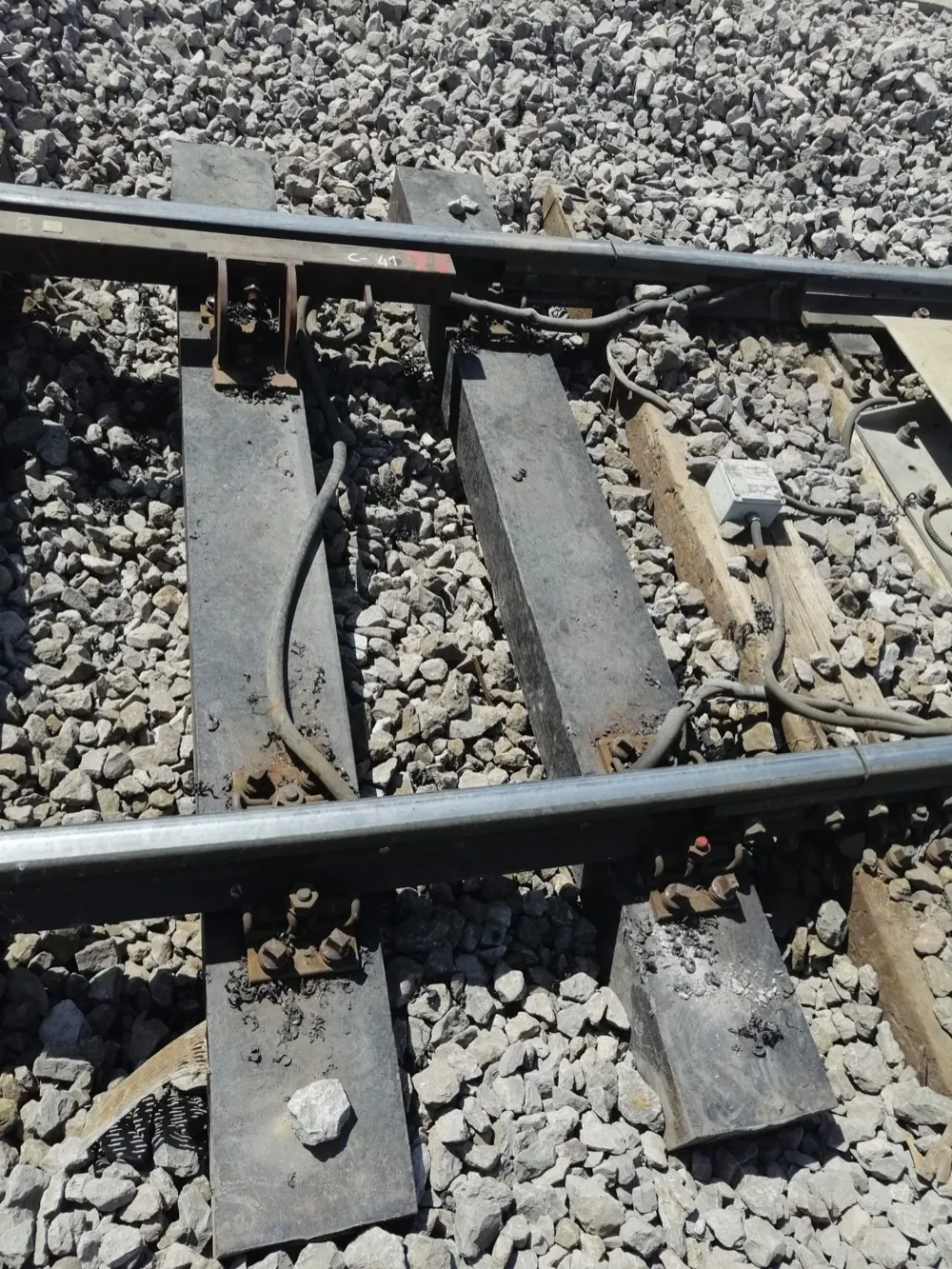
Advantages
What the Rerawa
composite sleeper brings
A side-by-side comparison of sleepers made from different materials
| Criterion | Timber | Concrete | RERAWA composite |
|---|---|---|---|
| Manufactured from 100% recycled material | No | No | Yes |
| Maintenance frequency | High | Low | Low |
| Service life | 15 years | 40 years | +50 years |
| Production lead time | Very long | Long | Short |
| Creosote | Required | Not required | Not required |
| Insects, termites, fungi | Susceptible | Unaffected | Unaffected |
| Rot and water absorption | Present | Present | None |
| UV radiation | Susceptible | Unaffected | Unaffected |
| Electrical insulation | Insulating | Limited insulation | Insulating |
| Chemical resistance | Poor | Moderate | High |
| Unit weight (2600 mm standard track) | 100 kg | 250–320 kg | 110 kg |
| End-of-life recycling | None — hazardous waste | Difficult and costly | 100% |
| On-site workability | Limited | None | Straightforward |
| Coach-screw hole repair | Limited | Constrained and costly | Repairable with compound |
Product characteristics
What the composite delivers
- Service life beyond 50 years
- Manufactured from 100% recycled material
- Fully recyclable at end of life
- Contains neither creosote nor impregnation chemicals
- Tested to ISO 12856 test methods
- Sound and vibration damping
- Low thermal expansion and high dimensional stability
- Project-specific dimensions and hole layout
Durability
It does not rot,
absorb or conduct
Unaffected by insects, termites and fungi; it does not absorb water or rot. It resists UV radiation and has high chemical resistance. Electrically it is an insulator — a decisive difference for signalling on tracks where a concrete sleeper conducts.
After a derailment a composite sleeper takes far less damage than a concrete sleeper; in most cases a further replacement is not required.
Health
No
creosote
The impregnation and creosoting used to protect timber sleepers rely on carcinogenic chemicals. Rerawa composite sleepers are not impregnated; creosote and similar preservatives have no place in their manufacture.
A spent timber sleeper is classified as hazardous waste. A composite sleeper is ground and returned to production.
Logistics and site
Straightforward to move,
workable on site
A standard Rerawa running-line sleeper weighs 110 kg — close to timber (100 kg) and markedly lighter than concrete (250–320 kg). Crushing and handling damage in transit is low; no special equipment is required.
On site it is worked like timber: drilled and cut from any face, with coach-screw holes readily repaired using a compatible compound.